

Why x Data Centers Are the Foundation of Every Successful AdTech Expansion

Scaling AdTech infrastructure across the Americas demands more than rack space and bandwidth. An x data center serves as the strategic backbone for advertising platforms that require sub-20ms latency to major population centers, real-time bidding capabilities processing millions of transactions per second, and compliance frameworks spanning multiple regulatory jurisdictions from GDPR to LGPD. For technical decision-makers evaluating Pan-American expansion in 2026, the infrastructure choice directly impacts campaign performance, data sovereignty compliance, and ultimately, competitive positioning in markets where milliseconds determine auction winners.
The business case extends beyond pure technical specifications. Organizations expanding advertising operations across North and South America face a critical inflection point: centralized infrastructure that introduces latency penalties and regulatory exposure, or distributed architecture that multiplies operational complexity and cost. An x data center approach resolves this tension by positioning compute resources strategically within key advertising markets while maintaining unified management and security protocols. This matters because real-time advertising decisioning operates within strict time budgets where network latency alone can disqualify bids before creative quality or pricing ever enters consideration.
What separates effective data center deployment from expensive infrastructure experiments is alignment between physical location, network topology, and advertising workflow requirements. The facilities must deliver consistent performance during peak traffic events, maintain data residency for privacy-sensitive audience segments, and provide cost-predictable scaling as campaign volumes fluctuate seasonally. For platforms processing billions in advertising spend annually, infrastructure decisions compound into measurable competitive advantages or costly operational constraints that persist for years beyond the initial deployment.
What Makes x Data Centers Essential for AdTech Operations

AdTech platforms demand infrastructure that responds in milliseconds, not seconds. When a user loads a webpage, real-time bidding systems have roughly 100 milliseconds to evaluate inventory, submit bids, and serve creative assets, often competing against dozens of other demand-side platforms for the same impression. This operational reality makes traditional data center approaches inadequate for advertising technology at scale.
X data centers deliver three fundamental capabilities that separate functional AdTech platforms from failing ones: geographic distribution, carrier-neutral connectivity, and horizontal scaling architecture. Geographic distribution places compute resources within 50 milliseconds of major population centers, cutting the round-trip time that kills bid opportunities. A platform serving ads across the Americas can’t rely on centralized infrastructure in a single region without sacrificing win rates in distant markets.
Carrier-neutral facilities provide direct peering relationships with major internet service providers and advertising exchanges. This eliminates intermediary hops that add latency and cost to every impression served. When your infrastructure connects directly to Google’s Ad Exchange, The Trade Desk, and major SSPs through private interconnects, you’re shaving 10-20 milliseconds off each transaction while reducing bandwidth costs by 30-40%.
The architectural flexibility of x data centers supports the uneven scaling patterns inherent to advertising. Campaign launches can triple traffic within hours. Black Friday demand spikes dwarf normal loads. Seasonal fluctuations create massive variance between Q4 and Q2 inventory requirements. Infrastructure that can’t expand compute and storage independently will either overprovision year-round (wasting capital) or underdeliver during peak revenue periods.
High availability isn’t a luxury in AdTech, it’s a contractual obligation. When your platform goes offline, client campaigns stop spending and competitors capture that demand. X data centers provide redundant power, cooling, and network paths as baseline offerings, with SLAs typically guaranteeing 99.95% uptime or better. This reliability extends beyond the facility to your adtech stack context where every component from bid caching to creative rendering must maintain always-on availability.
For platforms processing billions of monthly impressions across continental distances, x data center infrastructure transforms from a back-office consideration into a competitive differentiator that directly impacts client retention and revenue growth.
The Pan-American Data Challenge: Why Location Matters

Latency and Real-Time Bidding Performance
In programmatic advertising, a 100-millisecond delay in bid response time can reduce win rates by 30% or more. When your data centers sit thousands of miles from key user populations, those milliseconds compound quickly. A bid request originating in São Paulo that must route to a data center in Virginia faces 120-150ms of network latency alone, before any processing occurs. By the time your latency-constrained RTB pipeline evaluates audience data, calculates bid price, and returns a response, competing bidders with local infrastructure have already won the auction.
The financial impact is substantial. For a platform serving 10 billion impressions monthly across the Americas, every 50ms of added latency translates to roughly 8-12% lower fill rates. On a $2 CPM inventory, that’s $1.6-2.4 million in monthly revenue lost to geographic disadvantage alone. The problem intensifies with premium inventory where auction timeouts are tighter, often 100ms total response windows.
Positioning x data centers within 50ms of your core audience clusters changes the equation entirely. Titane’s tri-node architecture across North, Central, and South America ensures bid requests from Mexico City, Toronto, or Buenos Aires reach decision engines in under 30ms. This proximity advantage doesn’t just improve win rates; it enables sophisticated data layer implications like real-time lookalike modeling and contextual enrichment that slower competitors must skip to meet auction deadlines.
Data Sovereignty and Regional Compliance
Operating an AdTech platform across the Americas means navigating a patchwork of privacy regulations that treat user data very differently. Canada’s PIPEDA requires meaningful consent and cross-border data transfer accountability. Brazil’s LGPD imposes strict localization requirements for certain data categories and grants users broad rights to deletion and portability. In the United States, state-level laws like California’s CPRA and Virginia’s CDPA create fragmented compliance obligations with varying definitions of sensitive data and consent mechanisms.
A distributed x data center architecture addresses these challenges by enabling geographic data segmentation. User data from Brazilian audiences can reside on infrastructure within Brazil to satisfy LGPD localization mandates, while Canadian user profiles remain on Canadian servers to simplify PIPEDA compliance audits. This physical separation of privacy-aware data by jurisdiction reduces legal risk and simplifies the technical implementation of region-specific consent workflows and deletion requests.
Beyond storage location, x data centers support compliance through access controls and audit logging that demonstrate which personnel accessed what data, when, and for what purpose, documentation required during regulatory investigations. For AdTech platforms handling millions of daily transactions, automated compliance at the infrastructure level beats manual oversight every time, turning regulatory complexity into a competitive advantage rather than an operational burden.
Infrastructure Requirements for Scalable AdTech Platforms
Compute and Storage Architecture
AdTech platforms processing billions of daily impressions need compute infrastructure that handles three distinct workload types simultaneously: real-time bid processing (microsecond-level decisions), audience segmentation (continuous data analysis), and campaign analytics (heavy computational queries). This demands a hybrid architecture mixing high-frequency CPUs for bid requests with GPU clusters for machine learning-driven audience modeling.
Storage configuration follows a tiered approach. Hot storage on NVMe SSDs keeps the most recent 24-48 hours of impression data and active audience profiles for sub-millisecond retrieval during bid evaluation. Warm storage on enterprise SSDs holds 30-90 days of campaign data for reporting and optimization, while cold object storage archives historical data for compliance and long-term trend analysis. A typical mid-sized platform serving 50 billion monthly impressions allocates roughly 60% of storage budget to hot tier, 30% to warm, and 10% to cold archival.
Memory architecture proves equally critical. In-memory databases cache bid rules, audience segments, and frequency caps, eliminating disk I/O latency during real-time decisions. Platforms often deploy 512GB to 2TB of RAM per bid server, with audience segmentation clusters requiring even more for processing terabyte-scale user graphs.
When managing hdata in your stack compute requirements increase substantially because privacy-preserving operations demand additional processing overhead without compromising bid response times. This typically means provisioning 20-30% extra compute capacity beyond baseline impression volume calculations.
Network Connectivity and CDN Integration

For AdTech platforms processing billions of impression requests daily, network architecture determines whether you win or lose bids in milliseconds-critical auctions. Your x data center’s connectivity layer must handle simultaneous connections to ad exchanges, demand-side platforms, and publisher endpoints across North and South America without introducing latency bottlenecks.
A robust network backbone starts with redundant high-capacity connections to multiple Tier 1 carriers. Direct peering arrangements with major ISPs reduce hop counts between your ad servers and end users, shaving precious milliseconds off creative delivery times. For Pan-American operations, establishing peering points in São Paulo, Mexico City, Toronto, and Miami ensures you’re positioned close to population density centers where most impression volume originates.
CDN integration transforms ad serving efficiency by caching creative assets at edge locations nearest to audiences. Rather than serving a video ad from your primary data center in Dallas to a viewer in Santiago, adding 120+ milliseconds of latency, CDN nodes deliver the asset locally while your core infrastructure handles real-time bidding logic and what hdata means for audience targeting.
Multi-CDN strategies further optimize delivery by routing requests through whichever provider offers the fastest path at any moment. For campaigns spanning diverse geographies, this approach compensates for regional performance variations between CDN providers, one might excel in Brazilian metros while another dominates Canadian markets.
The network layer also needs adequate bandwidth headroom for traffic spikes during high-value inventory periods like holiday shopping seasons or major sporting events, when bid volumes can triple within hours. Overprovisioning by 40-50 percent ensures campaign delivery doesn’t suffer during these revenue-critical windows.
Cost Optimization Strategies for Multi-Market Deployment
Expanding across multiple markets doesn’t mean building identical infrastructure everywhere. Smart AdTech companies balance performance requirements against capital expenditure by deploying different infrastructure tiers based on market size and revenue potential.
Start with a hub-and-spoke model rather than full data centers in every market. Major revenue markets like the US, Brazil, and Canada warrant dedicated facilities with complete infrastructure stacks. Smaller markets can be served through edge nodes, lightweight deployments handling regional ad serving and caching while relying on hub data centers for heavy processing and analytics. This approach typically reduces initial infrastructure costs by 40-60% while maintaining acceptable performance for most campaigns.
Hybrid cloud architectures offer another powerful cost lever. Reserve owned or co-located infrastructure for predictable baseline loads, your core bidding engines, persistent audience databases, and analytics platforms. Use public cloud services for burst capacity during high-traffic events or seasonal campaigns. An advertising platform serving Latin American markets might maintain permanent infrastructure for steady-state operations while spinning up additional cloud resources during World Cup or holiday shopping periods. This elastic model prevents overprovisioning for peak loads that occur only intermittently.
Data gravity significantly impacts ongoing costs. Store “hot” data, recent campaign performance, active audience segments, real-time bidding profiles, in premium storage close to processing resources. Archive historical campaign data and inactive audience profiles to lower-cost object storage that can tolerate higher retrieval latencies. One mid-sized AdTech platform reduced storage costs by 70% by implementing tiered data policies that automatically migrated campaign data older than 90 days to archive storage.
Network costs deserve particular attention in multi-market deployments. Direct peering with major ISPs and ad exchanges in each region dramatically reduces data transfer fees compared to routing all traffic through a single location. Negotiate committed-use contracts with bandwidth providers once your traffic patterns stabilize, volume commitments typically unlock 30-50% discounts versus on-demand pricing.
Consider infrastructure partnerships that spread deployment risk. Co-location in carrier-neutral facilities provides access to multiple network providers without capital investment in building construction, while managed services can handle routine operations, letting your team focus on platform development rather than hardware maintenance.
Building Redundancy and Failover for Always-On Advertising
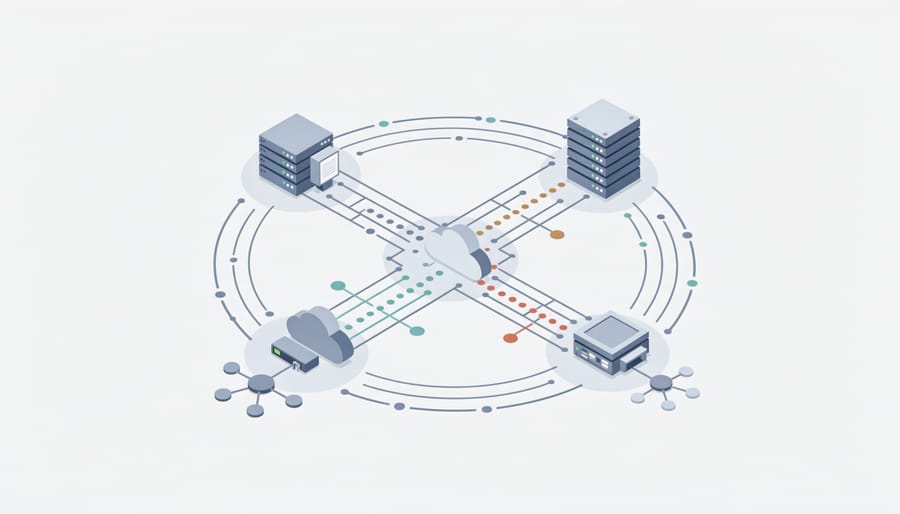
In advertising technology, downtime isn’t just an inconvenience, it’s a direct revenue drain for every stakeholder in the chain. When your platform goes dark during peak campaign hours, brands lose sales opportunities, publishers forfeit ad revenue, and your reputation takes a hit that spreadsheets can’t fully capture. For AdTech platforms operating across the Americas, where campaigns run 24/7 and audiences span multiple time zones, building redundancy into your x data center architecture isn’t optional infrastructure planning; it’s fundamental business continuity.
The industry standard for advertising platforms has converged around 99.95% uptime, which translates to roughly four hours of acceptable downtime per year. Many top-tier platforms push for 99.99% (less than one hour annually) because programmatic advertising operates in real-time, there’s no “catching up” on lost bid opportunities or impression delivery after your systems come back online. Each minute of outage during prime inventory periods represents thousands of failed auctions and diminished client trust.
Geographic distribution forms the foundation of effective redundancy. Deploying your infrastructure across multiple x data centers, ideally separated by hundreds of miles but within the same broad region to minimize latency, protects against localized failures from power outages, natural disasters, or network disruptions. For a Pan-American strategy, this might mean primary operations in Virginia with hot standby capacity in São Paulo and Toronto, ensuring that regional traffic can be rerouted without users experiencing degraded performance.
Active-active configurations, where traffic is distributed across multiple data centers simultaneously, offer superior resilience compared to traditional active-passive setups. When both facilities handle live production traffic, failover becomes seamless, if one location experiences issues, the other is already serving requests and simply absorbs the additional load. This approach requires real-time database replication and session state synchronization, but it eliminates the lag inherent in spinning up cold standby systems.
Automated health monitoring and failover mechanisms are critical because manual intervention introduces unacceptable delays. Your infrastructure should continuously monitor application responsiveness, database connectivity, and network performance, triggering automated traffic rerouting within 30-60 seconds of detecting failures. Configure your DNS and load balancing to support rapid cutover, and test these systems monthly, not just during annual disaster recovery drills when everyone’s paying attention.
Database redundancy deserves particular attention in AdTech environments where audience data, campaign rules, and billing records must remain consistent across systems. Multi-region database clusters with synchronous replication ensure that audience segments built in one location are immediately available in others, preventing the frustrating scenario where a failover triggers campaign delivery based on outdated targeting criteria. Accept that synchronous replication adds milliseconds of write latency; it’s a worthwhile trade-off for data consistency that maintains campaign integrity during failures.
Future-Proofing Your Data Infrastructure for 2026 and Beyond
The AdTech landscape shifts faster than most infrastructure can adapt. Your data center choices today determine whether you’re scaling efficiently in three years or explaining to investors why you need a costly infrastructure overhaul.
AI-driven optimization is no longer experimental, it’s becoming table stakes. Modern x data centers support machine learning workloads that predict traffic patterns, automatically allocate resources during peak bidding periods, and identify performance bottlenecks before they impact campaigns. These systems require GPU-enabled compute clusters and high-throughput storage architectures that can handle training datasets measuring in petabytes. Platforms that embedded this capability into their infrastructure early now process bid optimization 40-60% faster than competitors retrofitting AI onto legacy systems.
Privacy-preserving computation represents the biggest architectural shift since programmatic advertising emerged. Technologies like differential privacy, secure multi-party computation, and federated learning allow audience analysis without centralizing raw user data, critical as regulations tighten across jurisdictions. X data centers supporting these approaches need cryptographic acceleration, isolated compute environments, and network segmentation that maintains performance while enforcing data boundaries. The platforms investing in this infrastructure now will navigate the next wave of privacy legislation without rebuilding from scratch.
Edge computing pushes processing closer to users, reducing latency for time-sensitive operations like creative personalization and fraud detection. A distributed x data center architecture, anchoring in major metros while deploying edge nodes in secondary markets, creates flexibility. You can start centralized and selectively push workloads outward as specific markets justify the investment, rather than committing to full edge deployment before understanding regional performance patterns.
The infrastructure that survives market evolution balances current performance with architectural flexibility. Modular designs, vendor-agnostic standards, and separation between compute, storage, and network layers mean you can upgrade components independently as technologies mature. Build for what you need today, but architect for what you’ll need to compete tomorrow.
The competitive AdTech landscape across the Americas demands infrastructure decisions that shape market position for years to come. X data centers aren’t optional infrastructure, they’re the operational backbone that determines whether expansion efforts deliver measurable results or stall under technical limitations.
Companies scaling across North, Central, and South America face a stark choice: invest in distributed, high-performance infrastructure that meets regional compliance requirements and latency thresholds, or accept the operational penalties that come with inadequate data architecture. The difference shows immediately in metrics that matter, bid success rates, campaign delivery speed, and platform reliability under peak loads.
What sets successful Pan-American expansions apart isn’t just market presence but the technical capacity to process billions of impressions, analyze audience data in real time, and maintain consistent performance across jurisdictions with different regulatory frameworks. X data centers provide the foundation for these capabilities while supporting future adaptations as privacy regulations evolve and AI-driven optimization becomes standard.
The real competitive advantage emerges when infrastructure decisions align with business strategy. Organizations that treat data center architecture as integral to their expansion planning, not merely a technical requirement, position themselves to capture market share while competitors struggle with latency issues, compliance gaps, and scaling bottlenecks. In advertising technology, milliseconds and uptime percentages translate directly to revenue. The infrastructure supporting those metrics determines long-term viability in a market that rewards technical excellence and punishes operational shortcomings.
